

Cost per test in health institutions (CPT) How to calculate? Full calculation guide with up-to-date standards including direct, download and hidden costs.
Cost Per Testing in Health Institutions (CPT) What is?
Cost Per Test (Cost Per Test – CPT), all expenses arising out in the process of conclusioning a specific test in a clinical laboratory for one patient (reagentThe consumable material, labor, device amortisman and general expenses are the basic financial metric obtained by division of the total number of tests produced. In the simplest form, this calculation reveals a test cost of the institution and creates the basis of pricing strategies with profitability.
For laboratory managers and hospital finance departments CPTnot only an accounting term; It is also the most clear indicator of efficiency, waste management and device park optimization.
CPT Why Do I Have a Importance of Life?
In today’s competitive health sector, profit margins are increasingly involved. Private fuses or SGK Health Application Communiqué of state institutions such as Social Security Institution (Social Security Institution) (SUT) The refund jeans set out through restrict the financial movement area of the laboratories. While most hospital managers focus only on the tender price of the device or reagents, they forget the operational load on the background. Here’s exactly at this point CPT calculation is a vital compass function.
When a correct cost analysis is not done, they can produce “yellow” tests without being aware of hospitals. Comparing tests (in-house) which were worked in the institution with tests specifically sent out (outsource) (Make-or-Buy decisions), but also transparent CPT It is possible with analysis.

Comprehensive CPT Basic Components of calculation
To find the actual cost of a test, you need to deposit all factors that affect the production of that test into the table. These spending pens are generally divided into three main categories: Direct, download and hidden costs.
Direct Costs: Face Viewed (Reactives and Consumables)
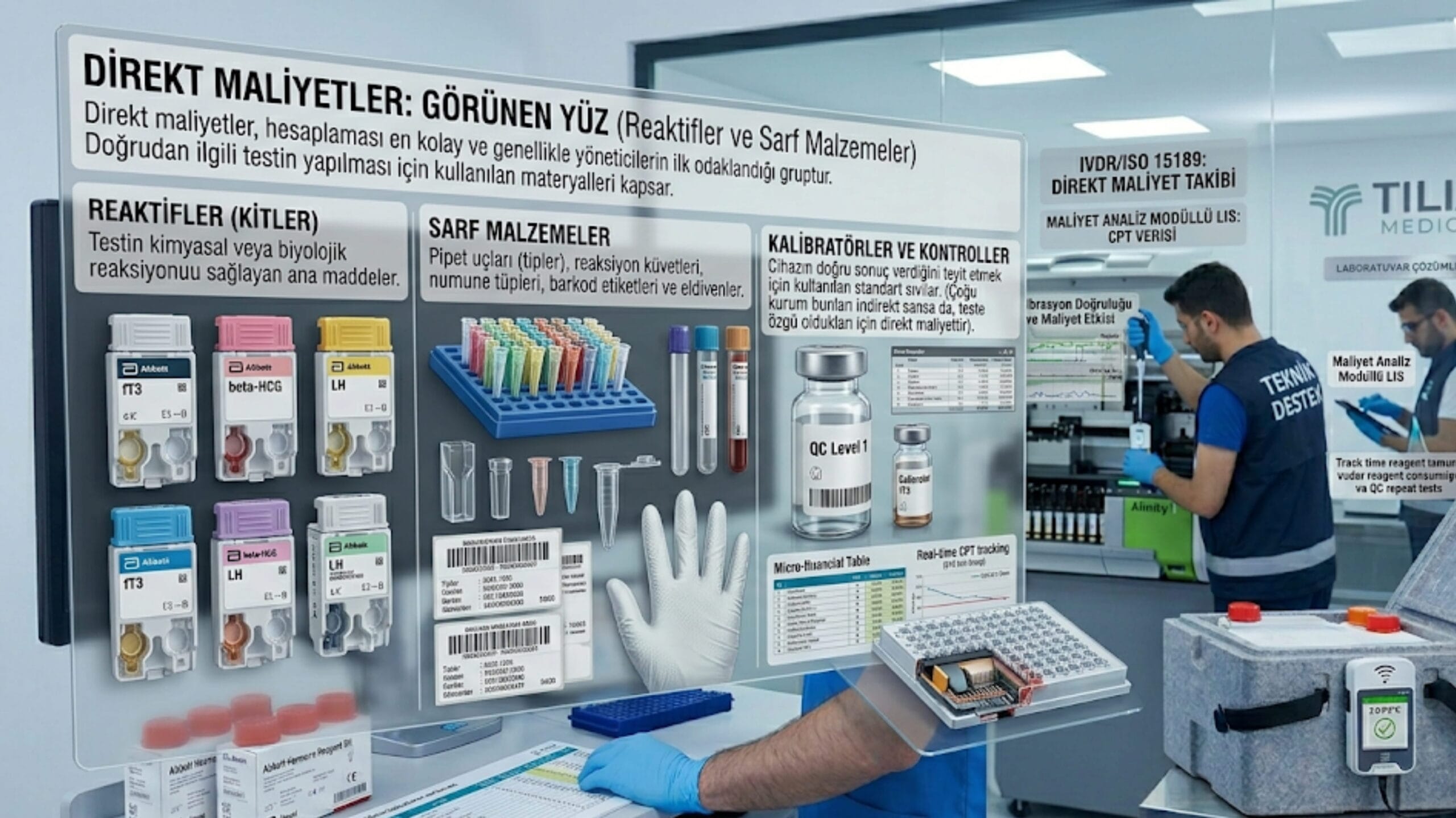
Direct costs are the easiest to calculate and often group managers focus on the first. It covers materials used for direct-related testing.
- Reactives (Kits): The main ingredients that provide the chemical or biological reaction of the test.
- Consumables: Pipette ends (types), reaction tubs, specimen tubes, barcode labels and gloves.
- Calibrators and Controls: Standard liquids used to confirm the correct result of the device. (In the case of reducing these institutions, the direct cost is because they are specific to the test).
Labor Costs (Personel Expenses)
Starting from the process of taking blood (flebotomi), the centrifuge of the specimen is the cost of labor all the time passing by the specialist physician (patologist or biochemistry specialist).
There is a fine detail here: You can not split the salary of a technician directly into the test. When the technician is actively interested in that test (hands-on time) should be calculated. In full-automatic systems, labor cost ceilings in operations such as manual microscope or culture plantings while shortening this time.
Download Costs (General Expenses)
It is necessary to maintain the presence of the laboratory but they can not be attributed directly to a single test. This is exactly what most people jump.
- Infrastructure & Energy: Electricity, water, air conditioning and seamless power supplies consumed by the laboratory (UPS) expenses.
- Waste Management: Payables for safe destruction of medical waste (especially for dangerous chemicals).
- Software & IT Infrastructure: Server costs and data storage costs.
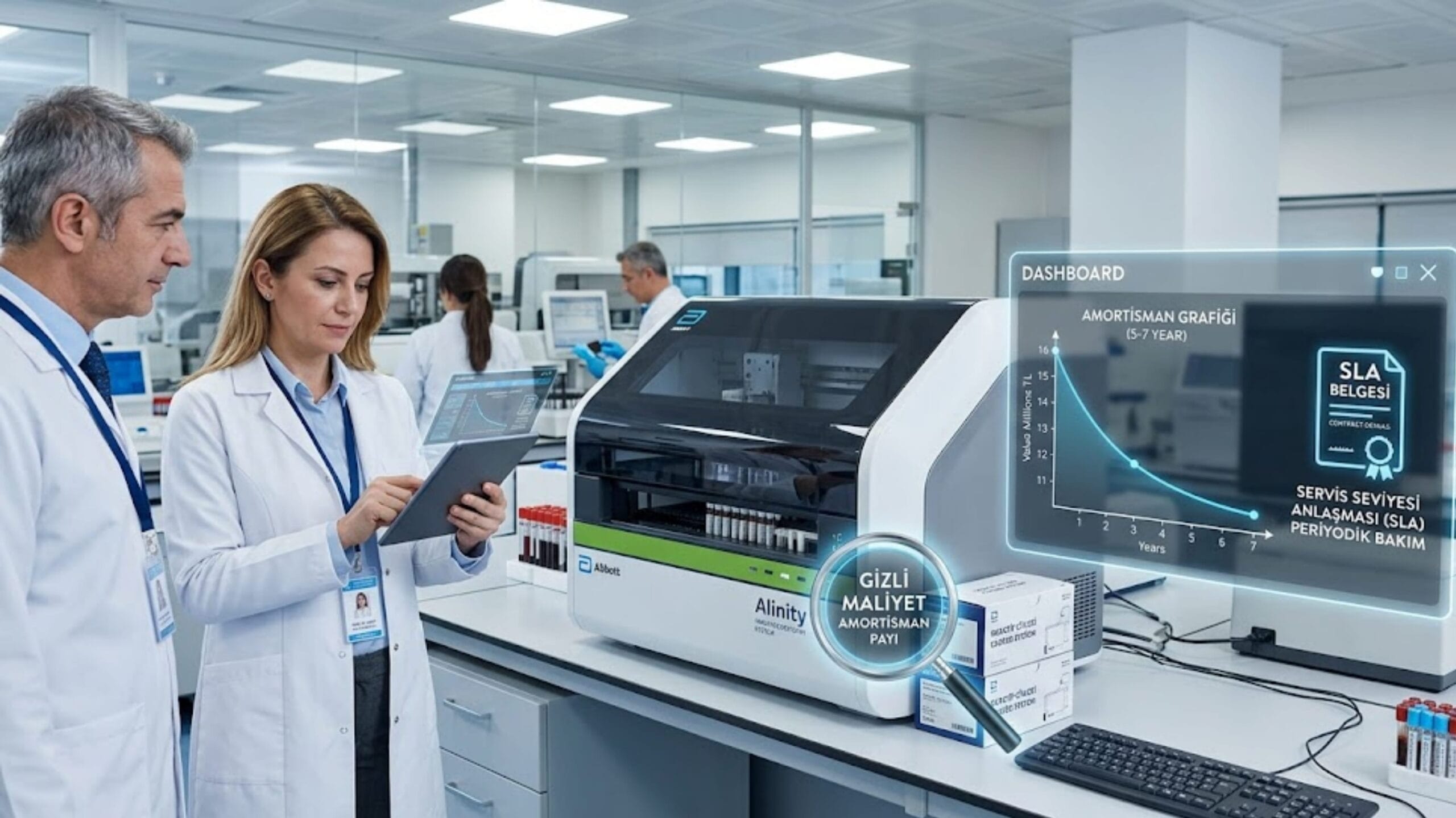
Device Amortisman and Maintenance Contracts (SLA)
Millions of lira analyzers have a lifetime of use (usually 5-7 year). The purchase price of the device (or leasing expense) should be divided into the number of tests annually. In addition, periodic maintenance, replacement spare parts and service Level Agreements made with companies for failure of the device (SLA) is a serious cost pen. Although the device appears as “free” in closed system (reagent tie-in) contracts, the cost of the device is secretly defeated to the reagents.
CPT Calculation Table: Comparison of Direct and Download Expenses
Let’s take a look at how the goes pens for a standard biochemistry laboratory to grasp the topic more clearly:
| Expense Pen | Type | Calculation Method / Difficult Degree | Impact Rate (Cahmini) |
| Reactive and Kites | Direct | The net amount per test is certain (Easy) | %40 – %60 |
| Pipe Consumables (t, Tube etc.) | Direct | It is withdrawn from the Sarprice reports (Easy) | %5 – %10 |
| Technician / Specialist Labor | Download / Semi-Direct | Time/steam requires pulse (Zor) | %15 – %25 |
| Device Amortisman and Maintenance | Download | Split device life and annual test volume (Common) | %10 – %20 |
| Electric, Water, Medical Waste, LIS | Download | The total volume of the laboratory is proportioned (very Hard) | %5 – %10 |
Steps CPT ( Cost Per Test) How to Calculate?
Let’s pour the theory into the pratia. A Perfect CPT Following for analysis 4 You need to follow the step respectively:
- Data Acquisition and Period Determination:
The first step is the time interval to be analyzed (e.g. last 1 year) to determine. Laboratory test volumes indicate seasonal fluctuations (for example, respiratory tract panels increase in winter). That’s why 1 per month data may be misleading; Minimum 6 monthly or annual data should be used.
- Calculation of Total Expenses:
within the selected period; All reagents are collected the percentage of paid technicians salary, device maintenance contract costs and the share of the general expenses (electric, waste) to the laboratory.
- Reportable Test Number (Billable Tests) Applicant:
Now there is a very important distinction here. Runs the device All The test is not tested to the patient. Calibrations, free (blank) readings on the opening of the device in the morning, quality control (QC) The serums and faulty tests (repeats) can not be billed to the patient. Therefore, you should not put the number of “Total Worked Test” in the share, “ ⁇ able (Billable) Test”.
- Implementation of mathematical formula:
Our formula is in the most basic form:
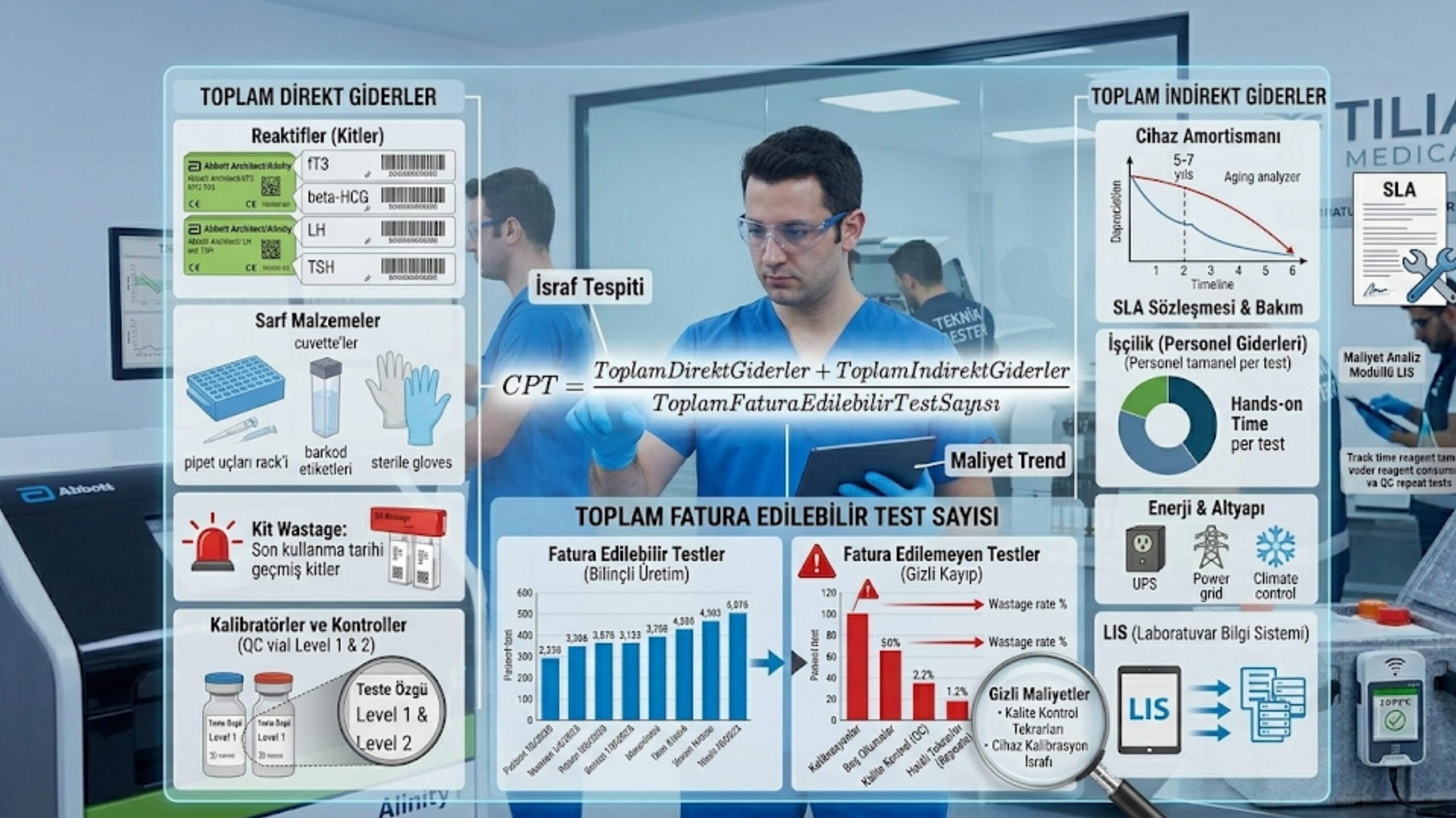
If we look at a driver from the real world; Annual total laboratory expenses 5.000.000 TL and year 1.000.000 in a hospital, which produce one invoiceable test, average CPT 5 TL. But each test (e.g. a complex with a Hemogram PCR Since the cost of the test is not the same, this formula should be subjected to sub-sections (micro costing) on each test parameter basis.
CPT Software and Tools Used in Calculator
Excel tables can initially work for small-scale laboratories; but monthly hundreds of thousands of tests produce manual calculation for a modern hospital, maximizing error share (human factor). Nowadays, there are advanced tools that automate cost analysis.
- Corporate Resource Planning (ERP) Software: SAP Health/Hospital modules of large systems such as Oracle reflect the warehouse outlets directly to the cost. When a box is reaggent from the warehouse, the system automatically divides it into the test volume produced by that day CPT can create trend.
- Private Business Intelligence (BI) Solutions: Power BI or Tools like Tableau offer “Görsel Dashboards” to managers by combining financial data and transaction data from devices. In which test group is damaged, it can be detected instantly with color codes.
- Cost Analysis Module LIS (Laboratory Information Systems): The new generation of information systems manage financial data, not only medical results.
LIS Cost Integration with (Laboratory Information System)
Data lies in the heart of cost calculation and the main source of this data LIS(Laboratory Information System). Modern LISnot only patient results from devices; It also saves the device consumes several milliliters of reagents, as well as how many tests are repeated due to quality control installation.
LIS The advantages of an integrated cost management are:
- Real Time Tracking: When the reactive lot number changes and quality control fails, and the tests are repeatedly repeated, CPT instantly rises. LIS It can notice the situation and alarm the laboratory manager.
- Detection of waste: The number of tests that are billed to the patient with the amount of exagent from the device’s warehouse LIS paired over. The cliff on the ground refers to a serious calibration or expiration date past kit waste (wastage).
2024/2026 Current Standards and Regulations
Because medical laboratory management directly affects human health and high-scale financial cycles 2024 and especially 2026 When approaching the midges, laboratories have been serious standard updates that affect cost calculation methods.
ISO 15189:2022 Revision and Resource Management:
Determines quality and qualification requirements for medical laboratories ISO 15189 The final revisions of the standard expect not only clinical quality from laboratory management, but also a sustainable “source management” (Resource Management). The devices consume unnecessary reagents, not only the cost problem, but also against audits as an ineffluent to the “Risk Management” substance of the standard.
IVDR (In Vitro Diagnostic Regulation) Effects:
New In Vitro Diagnostic Devices Regulation of the European Union (IVDR), the kit producers have brought much more stringent clinical evidence requirements. This situation is to delete reagents from the “cheap but poor quality” on the market, hence the reliable and regulated reagents (and naturally CPT́s) has led to increase. Laboratories when making cost analysis IVDR It is necessary to reflect these price updates brought by compatible kits into long-term budgets.
KVKK / GDPR and Financial Data Security:
Custom software and cost-accounting ERP systems When working, patient data is used during the calculation of invoiceable tests. 2026 According to cyber security norms, CPT direct patient identification information of any financial module that accounts and data to the cloud (cloud) (TCKNName) should not be access. Data should be analyzed in statistical stack (big data) by fully anonymous.

Frequently Asked Questions (SSS)
CPT What are hidden costs in calculation?
Hidden costs; The date of termination of use has passed and the kit has been thrown into waste, the samples that have been forced to be reworked due to a device failure, the excess electricity consumed by high-voltage centrifuges and the external quality control to be accredited (EQAS) The annual participation fees paid to the programs. These are usually invisible in direct invoices but the total cost is %15-20 can increase the rate.
How can laboratory costs be reduced without reducing the quality of service?
The most effective method is to implement the principles of “Art Laboratory” (Lean Management). To prevent unnecessary steps of technicians by organizing workflow (processor yield), inventory management LIS By automating with integration, “Just-in-Time” (Full Time) is the safest ways of saving the kits to prevent end-use dates.
Cost Per Calibration Errors Test (CPT) How does it affect?
When a device is not calibrated correctly, it produces incorrect results. This leads to the doctor’s test back (re-run) Each repeat test without invoice; means more reagents, extra consumables and extra labor. Bad calibration, test CPT can double the rate instantly.
SGK or in special insurance payments CPTWhat is the role of ?
When calculating institutions, profitability CPTBased on . Yours CPTYour ́s (for example) B12 for test 15 TL), SGK⁇ SUT the amount of refund set in the list (for example, 12 TLIf on it, it means that you are structurally damaging from the test. CPTKnowing clearly is the most powerful negotiator in your hand while sitting on the table with special health insurances and corporate agreements (iskonto rates).