


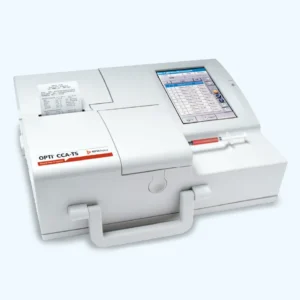
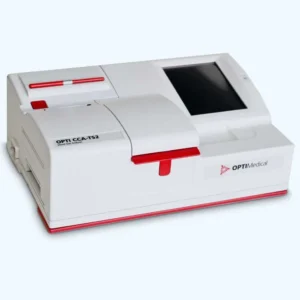
Who is OPTI Medical Systems?
OPTI Medical is a subsidiary of IDEXX Laboratories; its operations are in Atlanta, Georgia. Portable OPTI blood gas analyzers entered the US market in 1995 under the name AVL Medical Instruments. AVL has been producing blood gas analyzers since 1967. According to OPTI, more than 10,000 instruments are in use worldwide. The target audience is small and medium-sized hospitals. Points of use are the emergency department, the operating room and cardiac monitoring units, that is, units where results are needed quickly. Besides these instruments, the company also produces COVID-19 and influenza PCR tests; the information below covers blood gas products only.
Electrode-free measurement: optical fluorescence
The distinguishing feature of OPTI analyzers is their sensor technology. Instead of electrodes, the instrument works with optical sensors called optodes and measures the fluorescence emission of the sensors. All components required for calibration are inside the single-use cassette. The manufacturer states that this design eliminates electrode maintenance costs and that standby cost is zero because the consumable is used only during measurement. This advantage must be calculated against the institution’s workload: it is clear in a laboratory that receives a few samples a day, whereas in a laboratory that receives hundreds of samples, cassette cost comes to the fore.
OPTI at Tilia Medical
Tilia Medical has two product pages under the OPTI brand: OPTI CCA-TS2 Blood Gas and Electrolyte Analyzer and the previous-generation OPTI CCA and CCA-TS analyzers. An article on the brand’s corporate structure and instrument family is also available: OPTI Medical Systems.
Technical summary of the CCA-TS2 (manufacturer data)
- Sample: whole blood, serum or plasma; 125 µL (60 µL with the B60 cassette)
- Calibration time under 90 seconds, measurement under 120 seconds
- The measurement chamber is heated to 37 °C, and the operating temperature is between 10 and 30 °C
- Cassettes are individually packaged, with 25 per box; shelf life is 6 to 12 months from production
- 500 patient records, 300 user IDs, ASTM, ASCII and POCT protocols over USB or Ethernet
- Approvals: CE, UL, IVDD and FDA
Cassette selection
Cassette selection depends on the clinical need. The B-type cassette provides pH, PCO2, PO2, tHb and sO2. The E-Ca, E-Cl and E-GLU cassettes add sodium and potassium to these, along with calcium, chloride or glucose respectively. B-LAC is for lactate. B60 measures only pH, PCO2 and PO2 but works with a small sample volume of 60 µL; this is a useful feature for patients whose sample volume is limited. Because the shelf life of cassettes varies between 6 and 12 months, stock planning should follow test volume; expired cassettes raise cost.
The product group also includes the ComfortSampler arterial blood gas collection set and an online quality assurance program. Because the way a blood gas sample is collected affects the result, set selection should be evaluated together with test volume. For price and stock information, the contact form or info@tiliamedical.com can be used.
Frequently asked questions
No. The instrument does not use electrodes. According to the manufacturer, the optical fluorescence sensors (optodes) are located in the single-use cassette, and the instrument has no electrode maintenance.
Whole blood, serum or plasma. The sample can be applied by syringe, capillary tube or ComfortSampler.
The sample volume is 125 µL, or 60 µL with the B60 cassette. Measurement time is under 120 seconds, and the typical full cycle is under 210 seconds.
B, E-Ca, E-Cl, E-GLU, B-LAC, B60 and E-Lyte CCA. All except E-Lyte CCA include pH, PCO2 and PO2 measurement. Electrolytes, glucose and lactate vary by cassette.