
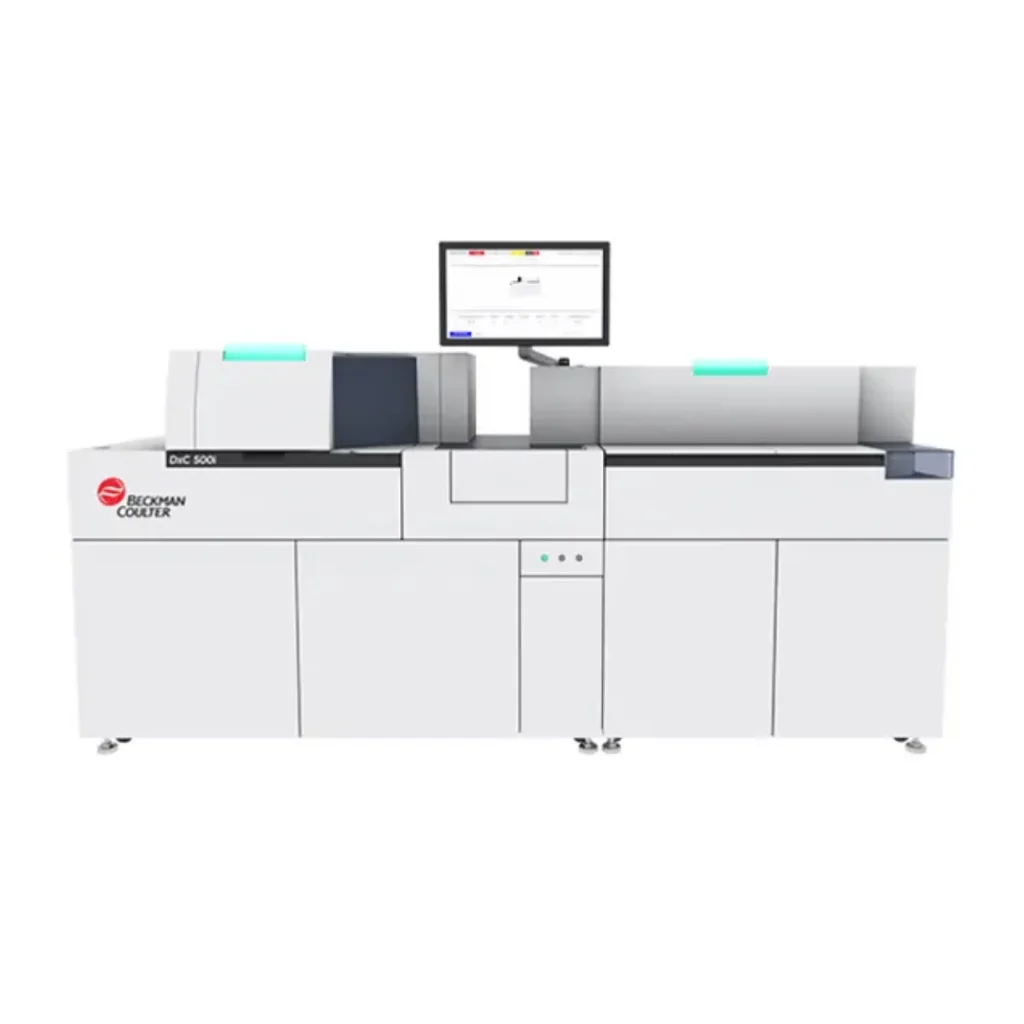
About the product
The DxC 500i Clinical Analyzer is an integrated system from Beckman Coulter that combines clinical chemistry and immunoassay modules in one instrument. According to the FDA 510(k) document, the instrument brings the DxC 500 AU Clinical Chemistry Analyzer and the Access 2 Immunoassay System together in a single instrument offering. The system is for in vitro diagnostic use only.
System features
The measurement principles stated by Beckman Coulter are spectrophotometry and potentiometry. On the immunoassay side, measurement is based on chemiluminescence. On the chemistry side, colorimetry and turbidimetry are used. Latex agglutination and indirect ISE methods are also listed. The immunoassay module uses antibody- or antigen-based methods bound to paramagnetic particles. Assay types include competitive and sandwich formats as well as antibody detection.
According to the FDA document, the instrument has a single user interface and a shared entry point for sample racks. The sample management unit works as a parallel processor for both sides.
Technical information
- Variants: C92752 (with ISE) and C92753 (without ISE)
- Throughput: photometric chemistry 400 tests/hour; with ISE 800 tests/hour; ISE only 600 tests/hour (manufacturer's statement)
- Throughput: immunoassay 100 single-step tests/hour; HbA1c only 65 tests/hour (manufacturer's statement)
- Time to first result: as little as 8 minutes for chemistry; 18 minutes for immunoassay panels such as βhCG (manufacturer's statement)
- Menu: more than 170 preprogrammed chemistry assays; availability varies by country
- Sample types: serum, plasma, urine, CSF, whole blood and amniotic fluid (depending on the test)
- Sample capacity: 168 tubes (24 racks of 7); independent STAT chemistry carousel with 22 samples; immunoassay carousel with 60 samples
- Reagent capacity: 76 refrigerated chemistry positions and 24 refrigerated immunoassay positions
- Sample volume: 1.0 to 25 µL for chemistry and 10 to 110 µL for immunoassay (depending on the test)
- Calibration stability: up to 90 days for chemistry and up to 63 days for immunoassay
- Sample checks: lipemia, hemolysis and icterus indices and clot detection
- Connectivity: ASTM protocol for LIS; serial or TCP
Use and compatibility
According to information from Beckman Coulter and the FDA document, the operating approach is as follows:
- A single tube can be used for both chemistry and immunoassay tests
- Reagents and consumables can be loaded while the system is running
- While one side is under maintenance, the other side can continue running tests
- The system works with the existing reagents, calibrators, controls and system solutions of the AU and Access instrument families
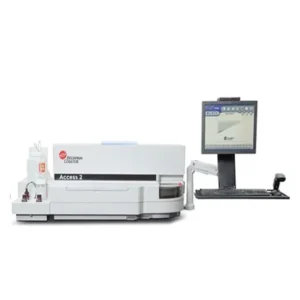
For brand information, see the Beckman Coulter page, and for the standalone version of the immunoassay module, the Access 2 Analyzer page. Other instruments are listed in the test devices category.
The test menu varies by country and regulatory status. For the availability of a specific test, refer to the manufacturer’s information.
Frequently asked questions
Beckman Coulter states spectrophotometry and potentiometry for chemistry and chemiluminescence for immunoassay.
According to Beckman Coulter, a single tube can be used for both chemistry and immunoassay tests.
Beckman Coulter lists serum, plasma, urine, CSF, whole blood and amniotic fluid, and states that the sample type depends on the test.
Contact
For product, quotation and technical information requests, use the contact form or write to info@tiliamedical.com.