
About the product
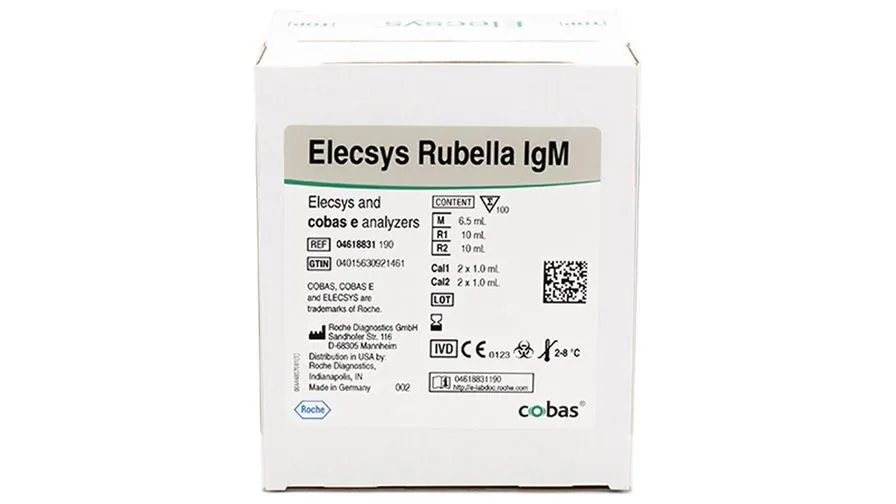
Elecsys Rubella IgM is Roche Diagnostics’ electrochemiluminescence immunoassay (ECLIA) test for the in vitro qualitative determination of IgM antibodies to rubella virus in human serum and plasma. According to Roche, the test aids in the presumptive diagnosis of acute or recent rubella infection and is also used for women of childbearing age. Roche states that the test is not FDA-cleared for screening blood and plasma donors. For brand information, the Roche Diagnostics page can be consulted.
The parameter measured and its clinical meaning
According to the Roche method sheet, rubella virus causes a mild rash illness, usually seen in childhood. A primary infection acquired in early pregnancy, however, can lead to miscarriage or congenital rubella syndrome through vertical transmission of the virus. The World Health Organization (WHO) reports that the risk of transmission to the fetus in infection early in pregnancy is about 90 percent. Roche states that IgM antibodies generally point to acute infection, but that antibodies can persist for a long time.
The US Centers for Disease Control and Prevention (CDC) states that rubella IgG serology should be used to assess immunity. IgM testing should be limited to suspected rubella cases and is not recommended for screening people without symptoms.
Technical information
- Method: µ-capture ECLIA, qualitative (Roche method sheet)
- Steps: first the automatically diluted sample is incubated for 9 minutes with biotinylated anti-human IgM antibody and recombinant rubella antigen. In the second step, streptavidin-coated microparticles and ruthenium-labeled rubella-specific antibody are added (9 minutes). The microparticles are held on the electrode in the measuring cell, and light emission is measured (Roche method sheet)
- Test time: 18 minutes (Roche method sheet)
- Calibration: two-point. Traceability: to a Roche reference standard (Roche method sheet)
- Interpretation: COI below 0.8 is non-reactive, 0.8 to below 1 is borderline, 1 and above is reactive (Roche method sheet, FDA summary)
- Sample type: human serum and heparin, EDTA or citrate plasma (Roche product page)
- Packs: 100 tests and 300 tests; the 300-test pack is listed for the cobas e 402 and e 801 (Roche product page)
- Regulatory record: FDA 510(k) K092322, decision date March 12, 2010 (FDA summary)
Use and compatibility
Roche states that the test is designed for use on cobas e immunoassay analyzers only. The listed systems are the cobas e 411, e 601, e 602, e 402, e 801 and cobas smart e. Among Tilia Medical’s product groups, the cobas e 411 and cobas e 402 pages provide information on these analyzers. Interpretation of results is performed by the physician together with clinical findings and, where necessary, additional tests.
For product, quotation and technical information requests, the form on the contact page or info@tiliamedical.com can be used.
Frequently asked questions
According to the Roche method sheet, the result is given as a cut-off index (COI). A COI below 0.8 is non-reactive, from 0.8 to below 1 is borderline, and 1 and above is reactive.
According to the CDC, rubella IgG serology is used to assess immunity. IgM testing is limited to suspected rubella cases and is not recommended for screening people without symptoms.
Roche lists the test for the cobas e 411, e 601, e 602, e 402, e 801 and cobas smart e immunoassay analyzers. The test time is 18 minutes.